
Jurisdiction-grounded emergency exercises
Practice the decisions.
Strengthen the procedure.
Turn a real geographic picture into a controlled incident exercise. Put policy, coordination, and decision-making to the test—then examine the record.
For cities, counties, states, and the people responsible for preparedness.

The purpose
Evaluate policy and procedure
before the pressure is real.
City SeCUReD is an emergency-management exercise simulator and benchmarking harness. It gives exercise leaders a way to rehearse how people coordinate, authorize, communicate, and document decisions.
The scope is organizational policy and procedures: command relationships, resource requests, operational objectives, and accountable follow-through. The exercise leader defines the question and retains responsibility for interpreting the result.
Read the purpose and development status ↗From place to practice
A jurisdiction.
A scenario. A defensible review.
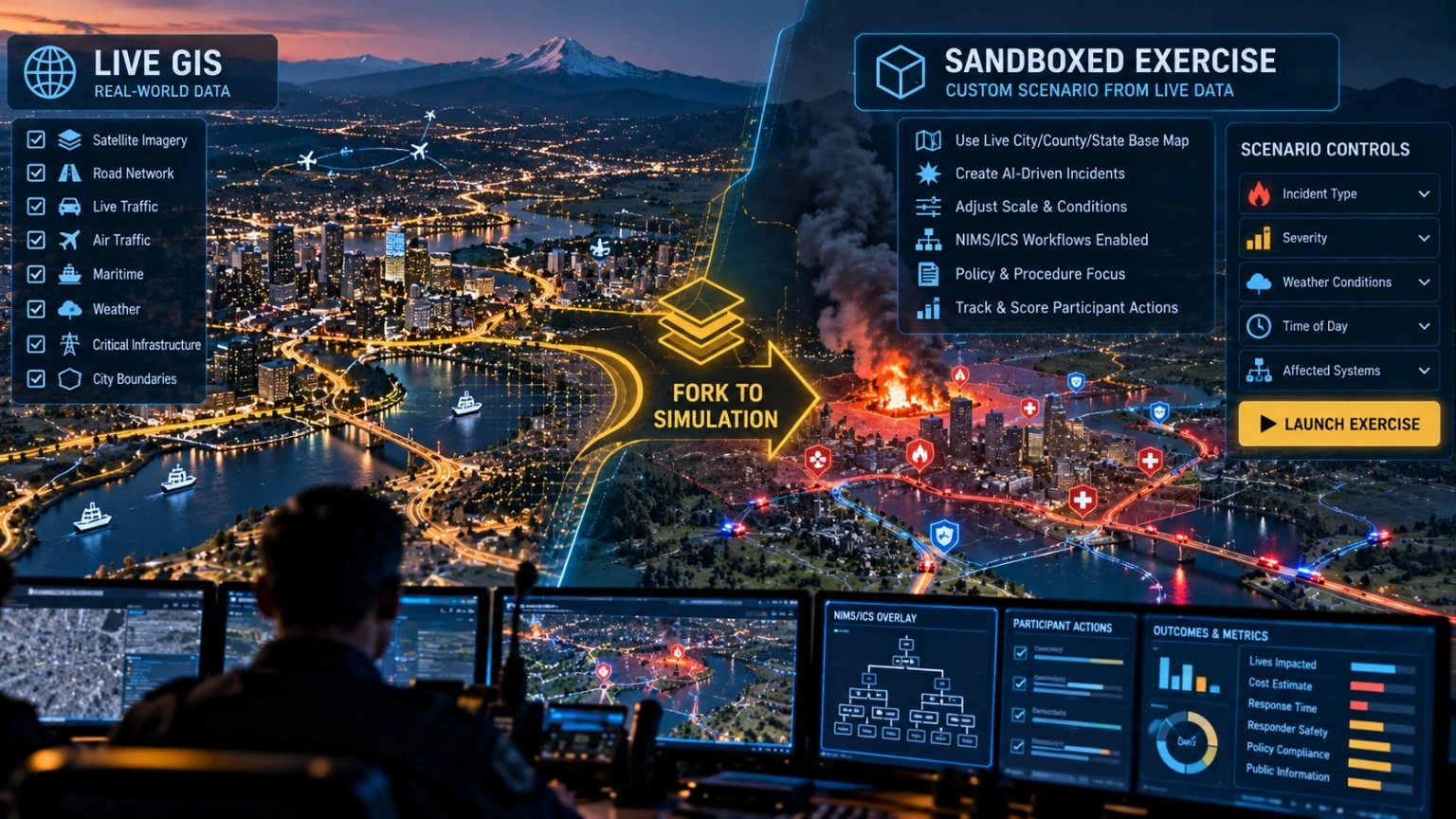
The full application workflow connects available geographic data to a deliberately isolated exercise. The web preview demonstrates a reduced version using sample data.
Start with the place you need to exercise.
Load a city by name and bring in road, boundary, and building layers. Add jurisdiction-provided GIS data for the area and scope of the exercise. Available feeds provide current context where supported.
Explore geographic data and coverage ↗Source, coverage, and freshness remain visible.
Capture a starting point. Keep it separate.
A fork copies the loaded world and its available picture at a known time. Live feeds are cut for the exercise; simulated changes stay inside the exercise copy and are marked EXERCISE.
See the exercise boundary ↗Independent exercise state · No write-back to operational systems
Customize the incident. Keep a human in charge.
The Scenario Director supports authored hazards, severity, exercise variables, and timed injects. Staff doctrine-defined positions with people, models, or deterministic controls. The human exercise leader controls the exercise.
Explore the demonstration ↗AI supports the scenario; the exercise leader owns the decisions.
Compare what happened against a stated standard.
Review observed actions, objectives, doctrine-based checks, and the record behind each finding. Benchmark matched scenarios and seeds to compare response strategies within the simulator.
Explore evaluation and benchmarking ↗Exercise findings support human review. They are not a prediction.
Doctrine is part of the architecture
More than a reference
on the side of the screen.
NIMS/ICS terminology, position responsibilities, state guards, and procedural operations are represented in the code. HSEEP provides the exercise-evaluation framework; project-specific mappings and scoring remain subject to practitioner review.
Explore the doctrine framework ↗For exercise leaders and public officials
A clear account
of what the exercise shows.
Compare the same scenario under different response strategies. Examine why a finding was produced. Use the record to discuss changes to policy and procedure.
The software is a research prototype. It has not been validated against real incidents, and the rubric has not received credentialed NIMS/ICS reviewer sign-off. Simulation results describe performance inside the simulator.
An accountable exercise starts with a clear question